
Learning from malaria about how our immune receptors work
Our bodies are patrolled by immune cells, such as natural killer cells. These cells need to make a choice whenever they contact another cell. If it is a pathogen, then they need to deploy their payload of toxins to destroy it. But if it is one of our own cells, then they need to avoid becoming activated.
To make these choices, immune cells use immune receptors. If inhibitory receptors are activated, then the natural killer cell will not kill. But if activating receptors are triggered, then the natural killer cell will be triggered to destroy its target.
One of the big questions about immune receptor function relates to a process known as ‘cis-signalling’ in which an immune receptor binds to a ligand found on the same immune cell. Does this cause signalling or not?
In this study, we make a surprising discovery about immune cell function by studying how the RIFIN proteins of the malaria parasite, Plasmodium falciparum, bind to the immune receptor LILRB1. The RIFINs are found on infected-erythrocytes and bind immune receptors found on natural killer cells, suppressing natural killer cell function and preventing parasite destruction.
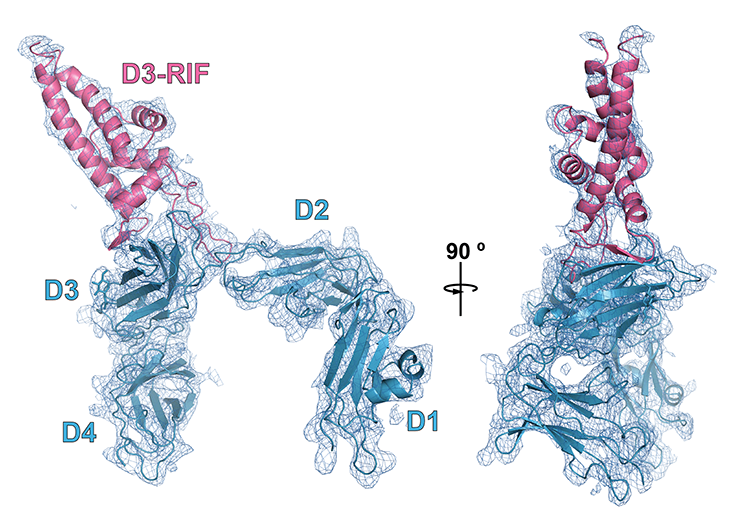
While LILRB1 is usually a linear, elongated molecule, we found that a group of RIFINs bind to LILRB1 and stabilise it in a novel buckled conformation. This buckled conformation is compatible with binding to the normal ligand of LILRB1, MHC class I, when both are presented on the same immune cell surface. Could this be a signalling complex? Guided by the structure of buckled LILRB1, we designed mutations which we could use to stabilise it in this novel buckled conformation. When we introduced buckled LILRB1 into immune cells, we found that it can bind to MHC class I on the same cell and that this trigger signalling through the receptor. This is the first demonstration that such cis-signalling can suppress immune cell function.
This study shows that LILRB1 can switch dynamically between different conformations. In its extended conformation, it can interact with ligands provided in ‘trans’ on different cells. However, when in the buckled conformation, it binds to ligands on the same cell, signalling and suppressing the function of the immune cell. Amazingly, the versatile malaria parasite has evolved to recognise either of these conformations of LILRB1, allowing it to suppress immune signalling whatever the state of LILRB1 and helping the parasite to survive.
Chamberlain, S.C., Widdess, M.A., Morch, A.M., Sakoguchi, A., Sakuno, R., Kurz, E., Chen, L., Vavlo, S., Iwanaga, S., Dustin, M.L. and Higgins, M.K. (2026) Immune receptor LILRB1 mediates cis-signalling which is targeted by RIFINs of the malaria parasite. BioRXIV https://doi.org/10.64898/2026.04.16.718981

