
How do African trypanosomes block function of the complement system?
The complement system is one of our major defences against pathogens. It consists of a set of molecules which our immune system uses to marks bacteria, viruses and parasites, targeting them for destruction. In order for a parasite to survive within our blood, it must resist being killed by complement.
African trypanosomes can survive within our blood for many years and have developed mechanisms which they use to resist killing by complement. We previously studied two trypanosome surface proteins, discovered by Olivia Macleod and Mark Carrington, which bind to complement components. But we suspected that there might be undiscovered complement regulators on the trypanosome surface.
Alex Cook decided to set up a large protein-based screen. He produced 39 different trypanosome surface proteins and screened them for the ability to bind to a set of different complement components. One particular protein stood out as the first trypanosome receptor for complement factor B.
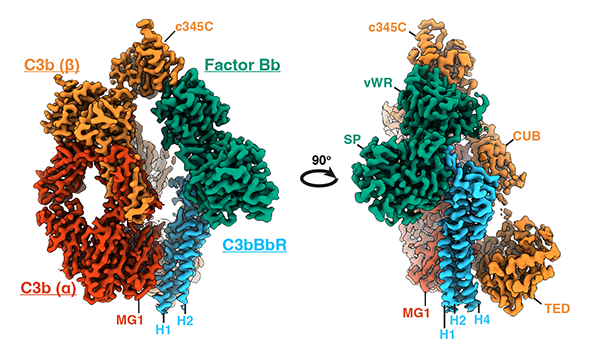
Factor B is central component of the complement cascade. The cascade centres around deposition of complement factor C3 on the pathogen surface. This requires complement factors B and C3 to bind together and for both components to be processed to form a C3bBb complex. This C3bBb convertase then recruits more C3 molecules to the pathogen surface, catalysing C3 deposition to mark the pathogen. A pathogen protein which targets factor B could therefore prevent this central step in pathogen marking by complement.
Alex therefore went on to investigate whether the factor B receptor affects C3bBb convertase function and he found that it does! Firstly, he showed that the receptor binds more tightly to C3bBb than to factor B. It is a C3bBb receptor. Second, he showed that the receptor does not prevent the formation of C3bBb convertases, but stops them from functioning by preventing the processing of additional C3 molecules into C3b. Finally, used structural biology to show how the receptor works, showing that it locks C3bBb in a conformation in which it can’t reach additional C3 molecules to process them.
These discoveries show that African trypanosomes have developed a wide range of approaches to stop the complement system. We expect that this is not the last complement regulator on the trypanosome surface! This new C3bBb receptor also has a novel way of regulating complement, not seen before for other pathogens, showing that we can learn from the ancient African trypanosomes how to regulate the core components of our complement system.
Cook, A.D., Webb, H., Minshall, N., Carrington, M. and Higgins, M.K. (2026) An African trypanosome surface protein inhibits amplification of the complement system. BioRXIV doi.org/10.64898/2026.08.17.745214

