
Can a parasitic worm teach us how to prevent asthma and allergy?
Tiny helminth worms can inhabit our intestines, happily eating our food. In order to survive long-term in this environment, they have evolved tricks which they use to suppress our immune systems. Fascinatingly they block some of the same immune processes that become activated in asthma and allergies. Can we learn from the worms how to prevent these illnesses?
In this study, we focused on a molecule secreted by the helminth H. polygyrus, known as HpBARI. HpBARI targets an important signalling pathway in which the human IL-33 cytokine binds its receptor ST2 on immune cells, triggering immune cell activation. This signalling pathway is often switched on in asthma and allergy and attempts have been made to generate therapeutic antibodies which block ST2 function. Disappointingly these antibodies showed low efficacy. Can we understand from the helminths how to make them better?
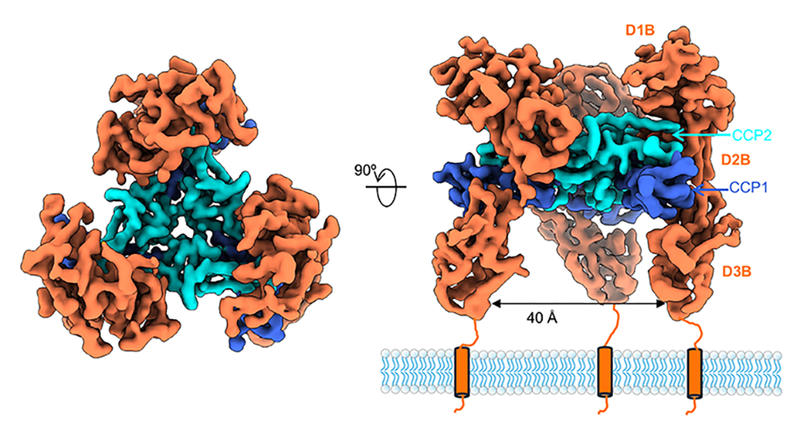
Abhishek Jamwal took on this challenge in collaboration with Henry McSorley. He first revealed the structure of HpBARI, showing that three HpBARI molecules come together in a flat, triangular arrangement. This HpBARI trimer binds to three ST2 receptors, in each case blocking ST2 from binding to IL-33 and holding ST2 in a shape which is not compatible with signalling.
The unexpected shape of HpBARI suggested a theory for how it works so effectively. In addition to the membrane-associated ST2 receptor, our blood also contains a soluble form of ST2 which can intercept ST2-binding antibodies to prevent them from reaching ST2 on immune cells, preventing them from affecting immune cell function. We reasoned that trimeric HpBARI would preferentially bind the membrane form of ST2, due to simultaneously binding three membrane-associated ST2 receptors on an immune cell surface, strengthening its binding. In contrast, it would bind each soluble receptor independently and therefore weakly compared to a membrane-bound receptor.
When Abhishek tested this theory, it turned out to be correct. HpBARI bound to membrane-associated ST2 receptors strongly and soluble ST2 could not effectively block binding. In contrast, when Abhishek engineered a form of HpBARI which only binds a single ST2, this could be effectively prevented from binding to membrane-associated ST2 by soluble ST2. Therefore, HpBARI trimerization allows it to selectively target and inhibit immune cells without being mopped up by soluble ST2.
Can we learn from this how to make better ST2-targeting therapeutics? The worms teach us that we should make molecules which simultaneously bind to multiple membrane-associated ST2 molecules and thereby avoid being mopped up by soluble ST2. Such a molecule could be very useful to prevent asthma and other allergic diseases.
Jamwal, A. Ong, N.W., Hodge, S.H, McSorley, H.J. and Higgins, M.K. (2026 The helminth-derived effector protein HpBARI trimerises to selectively target membrane-bound ST2 receptor BioRXIV doi.org/10.64898/2026.09.29.755424.

