
Structure-guided design of an improved PfCyRPA-based vaccine immunogen
One of the big goals of our team is to use structural insight to make the best vaccines. By determining how molecules from the surface of the malaria parasite are recognised by the best growth-inhibitory antibodies, we can design vaccine immunogens which specifically induce only the good stuff, by presenting only the epitopes for the most growth-inhibitory antibodies to the immune system. We have now completed a structure-guided vaccine design project to produce an immunogen based on the essential blood stage malaria molecule PfCyRPA.
PfCyRPA is part of the PfPCRCR complex, which is required for the deadliest malaria parasite, Plasmodium falciparumto invade our erythrocytes. If we can stop erythrocyte invasion, then we can prevent malaria!
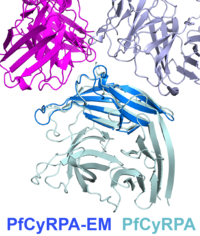
PfCyRPA is a protein formed from six triangular wedges, known as a beta-propeller. Our previous work (Ragotte et al 2022) showed that the most growth inhibitory antibodies targeting PfCyRPA bind to two of these wedges, known as blade 1+2. Therefore, we decided to produce a vaccine immunogen containing just these two wedges. However, this was challenging as blades 1+2 do not adopt the correct shape when removed from the context of the rest of PfCyRPA.
Nawsad Alam took on the challenging, leading a team to design a novel protein which mimics the surface of blades 1+2, PfCyRPA-EM. They showed that this molecule folds correctly, is easy and cheap to make and induces a higher quality antibody response that the whole PfCyRPA protein. This immunogen is now available for use in future blood stage malaria vaccines and we are excited to see how it works!
Alam, N., Wolfle, C., Butkeviciute, E., Quinkert, D., King, L.D.W. and Higgins, M.K. (2026) Structure-guided design of a PfCyRPA-based vaccine against blood-stage malaria. EMBO Molecular Medicine

