
Understanding how scavenger receptors form promiscuous “grabbers”
To protect us from toxic substances in our blood, we have cellular cleaning systems. These require receptors which selectively recognise and bind toxins. They face a challenge - to be sufficiently promiscuous to bind a range of toxic molecules - while not binding to molecules which should remain in the blood.
One such scavenger receptor is CD163. In this study we reveal more about how CD163 binds a diverse range of ligands.
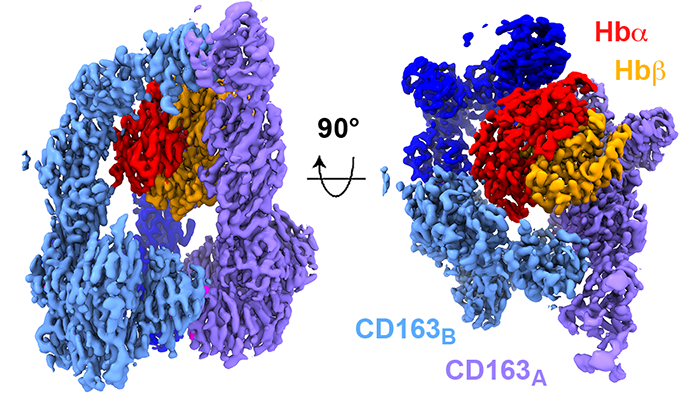
We previously showed how CD163 binds to the haptoglobin-haemoglobin complex. Haptoglobin-haemoglobin forms when our blood cells are damaged, releasing free haemoglobin. Haemoglobin is toxic when free and so haptoglobin is present in our serum to bind and inactivate haemoglobin, marking it for CD163-mediated uptake and destruction. We previously showed that CD163 has a triangular base from which three arms project. These arms come together like a ‘grabber’, creating a binding site for haptoglobin-haemoglobin to bind, allowing its detoxification.
However, in people suffering from some diseases, including genetic illness such as sickle cell anaemia, or infectious diseases such as malaria, large scale red blood cell lysis can deplete all of the haptoglobin from their blood. In these situations, CD163 can bind to haemoglobin and allow its uptake. How does CD163 adapt to bind to this different ligand?
We now show how CD163 adapts, with the three arms adopting different positions when bound to haemoglobin than when bound to haptoglobin-haemoglobin, creating a binding site with a different shape.
Therefore this amazing receptor can adapt by using flexible arms to grab differently shaped ligands, creating adaptable binding pockets to promiscuity scavenge a range of toxins and to keep us safe.
Zhou, R.X and Higgins, M.K. (2026) Structural Basis for hemoglobin scavenging by CD163 reveals mechanism of ligand promiscuity. PLoS Biology 24 e3003788

